

~History through Art ~
OTHER EXPLORERS, ADVENTURERS
& ICONS of HISTORY


Despite his competence at sea, Bligh’s leadership style has long been debated; he was known for being strict, sharp-tongued, and prone to verbal outbursts, though historical records suggest he was not unusually harsh by the standards of the time in terms of physical punishment.
William Bligh was a skilled but controversial officer in the Royal Navy, best known for commanding the HMS Bounty and for surviving one of the most famous mutinies in maritime history. Born in 1754, Bligh had an impressive naval background, having served under the legendary explorer James Cook during his third voyage to the Pacific, where he developed exceptional navigation and cartographic skills.
The voyage of the HMS Bounty began in 1787, when the vessel was dispatched on a botanical mission to the South Pacific. Its purpose was to collect breadfruit plants from Tahiti and transport them to the Caribbean as a cheap food source for enslaved people working on plantations.
After a long and difficult journey around Cape Horn failed due to severe weather, Bligh rerouted eastward via the Cape of Good Hope, eventually reaching Tahiti in 1788. The crew remained there for several months, enjoying the island’s relatively easy lifestyle, forming relationships with local people, and growing accustomed to a more relaxed existence than naval discipline typically allowed. This extended stay would later prove critical in undermining shipboard authority.


The infamous Mutiny on the Bounty occurred on April 28, 1789, shortly after the ship departed Tahiti. Led by Bligh’s acting lieutenant, Fletcher Christian, a group of discontented crew members seized control of the ship.
The causes of the mutiny remain complex and debated: tensions between Bligh and certain crew members, the allure of life in Tahiti, and the challenges of reimposing strict naval discipline all played roles.
Bligh and 18 loyalists were forced into a small open launch with minimal supplies, and cast adrift. What followed was an extraordinary feat of navigation and endurance, Bligh guided the overcrowded boat over 3,600 nautical miles to safety in Timor, a journey that cemented his reputation as an exceptional seaman.
Fletcher Christian and the mutineers returned briefly to Tahiti before seeking a remote refuge to avoid capture. A small group of mutineers, along with several Tahitian men and women, settled on the remote Pitcairn Island, a location so isolated that it was incorrectly charted on contemporary maps. This error worked in their favor, allowing them to evade the Royal Navy for years.
In 1790, shortly after arriving, the group made a decisive and symbolic move: they burned the HMS Bounty in what is now called Bounty Bay. The destruction of the ship ensured that none of them could easily leave the island, but it also eliminated any obvious trace of their whereabouts, effectively sealing their isolation.
Life on Pitcairn quickly deteriorated into violence and instability. Cultural tensions, jealousy, and disputes over relationships led to a series of conflicts between the mutineers and the Tahitian men. Within a few years, most of the original mutineers, including Fletcher Christian, were dead, many killed in violent clashes. By the early 1800s, only one mutineer, John Adams (also known as Alexander Smith), remained alive, along with a group of Tahitian women and numerous children. Adams eventually became the de facto leader of the small community and, in a notable turn, helped establish a more stable and religious society, reportedly using a Bible salvaged from the Bounty to guide the upbringing of the next generation.


The outside world rediscovered Pitcairn Island in 1808, when an American sealing ship stumbled upon the settlement. By then, the population consisted largely of the descendants of the original mutineers and their Tahitian companions. When British ships later visited, they found a surprisingly orderly and devout community, and rather than arrest Adams, authorities granted him clemency, partly due to the unique circumstances and the apparent reformation of the society.Today, Pitcairn Island remains one of the most remote inhabited places on Earth. Its small population, numbering only a few dozen people, is made up almost entirely of the direct descendants of the Bounty mutineers and the Tahitians who accompanied them.
The legacy of the mutiny lives on not only in historical accounts but also in the living lineage of the island’s residents, whose surnames, such as Christian, Young, and Adams, trace directly back to that dramatic chapter of maritime history.
Remnants of the HMS Bounty, including artifacts and the visible remains of the burned hull beneath the waters of Bounty Bay, still serve as tangible links to the past, preserving the story of survival, conflict, and the creation of a unique island community.
Bligh, upon returning to England, faced a court-martial, as was customary after losing a ship, but was honorably acquitted and continued his naval career, eventually rising to the rank of vice-admiral.
The legacy of the Bounty mutiny endures as a compelling tale of leadership, discipline, rebellion, and survival, often romanticized in literature and film, but rooted in the harsh realities of 18th-century naval life.

VASSdesign related Art

" HMS BOUNTY " by VASSdesign
Original design creation/artwork of HMS Bounty depicted in Tahiti, 1788.
" William Bligh " by VASSdesign
Vice-Admiral William Bligh, FRS ( 9 September 1754 – 7 December 1817 ) was a Royal Navy officer and colonial administrator who served as the governor of New South Wales from 1806 to 1808.
He is best known for his role in the mutiny on HMS Bounty, which occurred in 1789 when the ship was under his command.


" HMS Bounty Shipwreck "
by VASSdesign
As if taken from the wreck of the HMS Bounty 'Mutiny on The Bounty' in 1790, off of Pitcairn island after the ship was burned and scuttled by it's mutineers.

James Cook was one of the most accomplished and influential explorers of the 18th century, a figure whose voyages fundamentally reshaped European understanding of the Pacific Ocean and its surrounding lands.
Born in 1728 in Yorkshire, England, Cook rose from humble beginnings to become a master navigator, cartographer, and captain in the Royal Navy.
His early career was marked by meticulous skill in charting coastlines, most notably along the coast of Newfoundland, where his precision and attention to detail earned him recognition and set the stage for his later expeditions.

Cook is best known for his three major voyages to the Pacific, undertaken between 1768 and 1779.
On his first voyage aboard the HMS Endeavour, he was tasked with observing the transit of Venus from Tahiti, a scientific mission organized by the Royal Society. Following this, he continued to explore uncharted territories, becoming the first European to map the eastern coastline of Australia and circumnavigate New Zealand. His detailed charts were remarkably accurate for their time and remained in use for decades.


During his second voyage (1772–1775), Cook commanded the HMS Resolution on a mission specifically aimed at settling the long-standing mystery of Terra Australis, a massive, unknown land that many Europeans believed must exist in the southern hemisphere to “balance” the continents of the north. Determined to resolve this, Cook pushed his ships farther south than any explorer before him, navigating through dense fog, violent storms, and vast fields of pack ice.
In January 1773, he became the first recorded European to cross the Antarctic Circle, an extraordinary achievement at the time. He would cross it multiple times during the voyage, proving both his persistence and the growing capability of naval exploration. However, instead of finding a fertile continent, Cook encountered only ice-choked seas and harsh, inhospitable conditions. These repeated southern excursions demonstrated that if a southern continent did exist, it lay far deeper within the ice and was unlikely to be the rich, habitable land earlier theorists had imagined. Although he never sighted mainland Antarctica itself, Cook’s voyage effectively disproved the myth of Terra Australis as a vast, temperate continent. In doing so, he reshaped geographic understanding of the southern hemisphere and shifted the focus of exploration.
Cook’s third voyage (1776–1779) aboard the HMS Resolution and its companion ship, the HMS Discovery, was driven by the goal of finding the elusive Northwest Passage, an Arctic sea route linking the Atlantic and Pacific.
After sailing across the Pacific, Cook reached the Hawaiian Islands in 1778, becoming the first European to record formal contact with them. He named them the Sandwich Islands in honor of his patron, the Earl of Sandwich.


From there, Cook continued north along the west coast of North America, charting parts of what are now Alaska and British Columbia, and pushing into the Arctic through the Bering Strait. However, thick sea ice blocked further progress, forcing him to turn back.
Returning to Hawaii in early 1779, relations with the local population, initially friendly, began to deteriorate due to misunderstandings, cultural tensions, and disputes over stolen property.
The situation escalated at Kealakekua Bay, where an attempt by Cook to take a local chief hostage as leverage went wrong. A confrontation broke out on the shoreline, and Cook was killed during the clash. His death marked a sudden and violent end to one of history’s greatest exploratory careers, underscoring both the achievements and the deep cultural conflicts tied to European expansion.
In legacy, Captain Cook remains a towering yet debated historical figure. His voyages opened the Pacific to European influence, paving the way for trade, scientific advancement, and eventually colonization. Today, he is remembered both as a pioneering explorer and as a symbol of the profound and often disruptive impact of European expansion on Indigenous cultures around the world.

VASSdesign related Art

' James Cook ' Original design by VASSdesign
Original and unique creation commemorating Captain James Cook, a British explorer, cartographer, and naval officer

Sir Edmund Percival Hillary was a legendary New Zealand mountaineer, explorer, and philanthropist whose life became defined by courage, perseverance, and a deep sense of humanitarian duty.
Born in 1919 in Auckland, Hillary developed an early love for the outdoors and mountaineering, honing his skills in the Southern Alps of New Zealand.
His experience in these rugged landscapes, combined with his physical strength and quiet determination, prepared him for the ultimate challenge, ascending Mount Everest, the tallest mountain on Earth.
Mount Everest, the highest mountain on Earth at 8,848 meters (29,029 feet), rises from the rugged Himalayan range as a symbol of both natural grandeur and human ambition.
Known for its extreme conditions, freezing temperatures, thin air, and unpredictable weather, Everest has long challenged explorers and mountaineers determined to reach its summit.
Among those who answered this challenge was Sir Edmund Percival Hillary, whose name would become forever linked with the mountain’s history.

On May 29, 1953, Hillary, together with Sherpa climber Tenzing Norgay, achieved what no one before them had been confirmed to accomplish: reaching the summit of Everest.
They were members of the ninth British expedition, led by John Hunt, which had been meticulously organized following decades of failed attempts by earlier expeditions.
Battling extreme cold, thin air, and treacherous ice formations, Hillary and Norgay pushed through the final ascent, including the now-famous Hillary Step, a near-vertical rock face just below the summit.


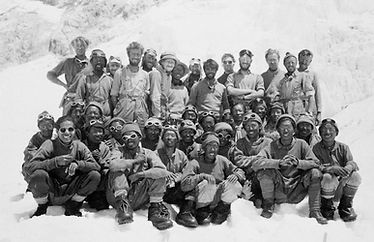

When they finally stood atop the world, they spent only a brief time there, taking photographs and leaving small tokens before beginning their descent, fully aware that survival depended on a safe return as much as the climb itself.
The success of the expedition brought worldwide recognition, and Hillary was knighted by Queen Elizabeth II.
Yet despite his fame, he remained humble and grounded, often emphasizing teamwork and the contributions of others—especially Norgay—instead of seeking personal glory.
However, his legacy extended far beyond mountaineering.
Deeply moved by the Sherpa people of Nepal, he dedicated much of his life to humanitarian efforts, establishing schools, hospitals, and infrastructure through the Himalayan Trust.
His work significantly improved living conditions in remote mountain communities and demonstrated a lifelong commitment to giving back.


Mount Everest remains more than just the tallest peak on the planet, it is a lasting symbol of human determination, courage, and the desire to push beyond known limits.
The historic ascent by Hillary and Norgay continues to inspire generations, while also reminding us of the mountain’s immense power and the respect it demands.
As climbers continue to pursue its summit, Everest stands as both a place of triumph and a testament to the enduring spirit of exploration.
VASSdesign related Art

'Edmund Hillary - Everest Conquered'
by VASSdesign
Edmund Hillary was a New Zealand mountaineer, explorer, and philanthropist.
On 29 May 1953, Hillary and Nepalese Sherpa mountaineer Tenzing Norgay became the first climbers confirmed to have reached the summit of Mount Everest. They were part of the ninth British expedition to Everest, led by John Hunt.
Original design created using Edward J Halliday's painting of Sir Edmund Hillary, 1955.
' Conquest of Everest ' by VASSdesign
Original design is a tribute to, and inspired by books and films on the subject during that era.

